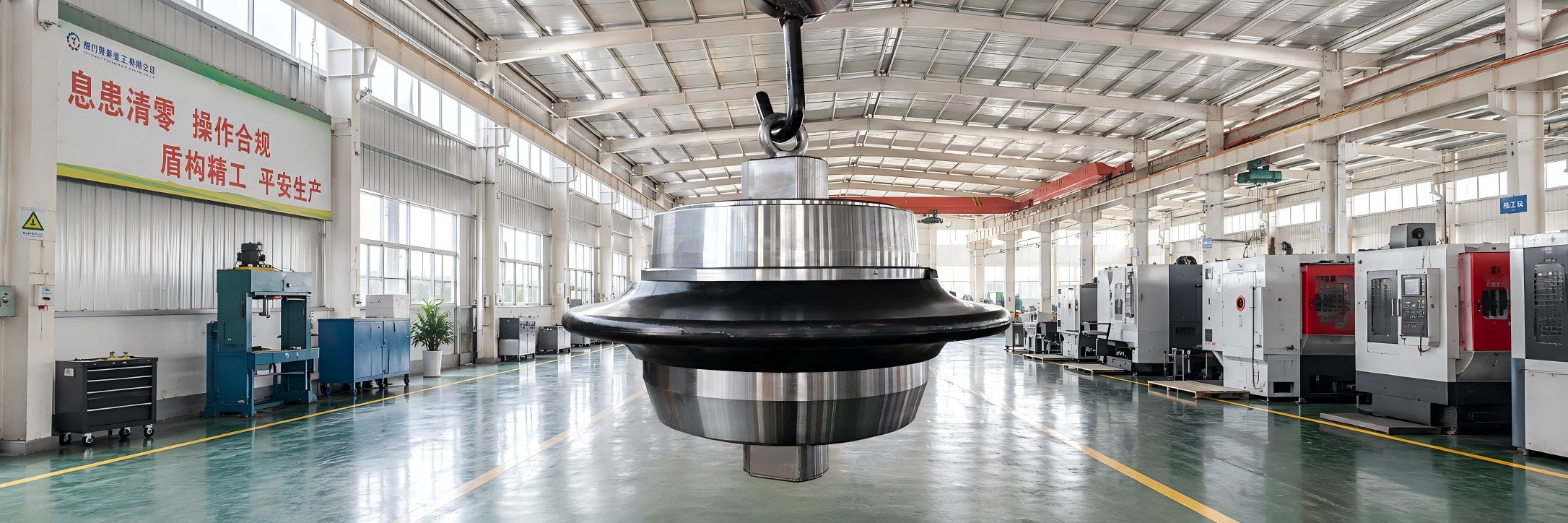
The condition of a TBM disc cutter cannot be judged by tunnelling distance alone. Cutters at different positions work under different loads, while ground conditions and rotation also affect how quickly damage develops.
Our previous article, Common Wear Patterns and Failure Modes of TBM Disc Cutters, explains how uniform wear, flat wear, ring fracture, bearing damage and seal failure appear. This article focuses on the next question faced by a maintenance team: Can the cutter remain in service, or should it be removed?
Actual inspection and replacement must follow the cutter manufacturer’s specifications, the TBM maintenance manual and the project’s safety procedure.
During an approved maintenance shutdown, remove loose material around the cutter ring and housing. Packed fines, mud or rock fragments can conceal leakage, restrict rotation and hide surface damage.
Confirm the cutter number and cutterhead position. Center, face and gauge cutters do not work under identical conditions. If records are available, check the last measurement and earlier comments.
Record at least:
Cutter number and cutterhead position
Cutter model or original diameter
Previous measurement, if available
Excavation interval since the last inspection or replacement
Wear can be checked with a model-specific cutter-ring wear gauge or a suitably sized vernier caliper. The gauge provides a direct wear reading. When outside diameter is measured with a caliper, radial wear is calculated as:
Radial wear = (original outside diameter − measured outside diameter) ÷ 2
Compare the result with the allowable radial-wear limit specified for that cutter model.
Measure several points around the cutter ring. Similar readings suggest uniform wear. A large difference may indicate eccentric or flat wear even when the average diameter remains above the replacement limit.
The wear value should be recorded consistently as radial material loss. A limit used for one cutter model should not automatically be applied to another 17-inch or 19-inch cutter.
Decision:
If wear is uniform and remains within the specified limit, record the measurement and continue monitoring.
If the minimum allowable diameter or wear limit has been reached, replace the cutter.
If measurements vary significantly around the ring, remove the cutter for further assessment rather than judging it only by the average value.
3. Check whether the cutter rotates normally
A cutter may remain within its wear limit but still be unsuitable because it no longer rotates correctly. Check it for excessive tightness, looseness or uneven resistance and, where appropriate, compare it with similar cutters.
Look for:
A cutter that cannot rotate
Binding or uneven resistance during rotation
Rough movement or unusual noise
Abnormal axial or radial looseness
A local flat area associated with restricted rotation
A seized or rough-running cutter should be removed so the bearings, seals, shaft and internal condition can be examined. Continued sliding can quickly turn a rotation problem into severe flat wear.
After refurbishment and reassembly, the cutter should rotate evenly and its starting torque should be measured and recorded. A cutter that is excessively tight, loose or uneven in rotation should be dismantled and rechecked. The acceptable torque must follow the assembly specification for the relevant cutter rather than a universal value.
4. Look for reasons to remove the cutter immediately
Some conditions do not require a long wear calculation. The cutter should be removed promptly for replacement or technical assessment when inspection finds:
A severe flat that affects rolling contact
A visible crack extending into the cutter ring
Large broken sections or serious cutting-edge damage
A loose, displaced or detached cutter ring
Oil or grease leakage together with rough rotation, seizure or abnormal play
Damage or deformation of the cutter body, shaft or mounting area
Any condition that does not meet the project’s safety or acceptance criteria
The causes are covered in the previous wear-pattern article. Here, the question is whether the cutter can safely complete the next operating interval.
5. Consider the next safe inspection opportunity
Access conditions, ground stability and the maintenance plan may limit the next opportunity to inspect the cutterhead.
If a cutter is close to its wear limit, estimate whether it is likely to remain serviceable until the next planned inspection. The decision should consider:
Current wear and recent wear progression
Cutter position and the condition of adjacent cutters
Expected ground conditions in the next drive section
Remaining distance to the next planned inspection point
The consequence of an unplanned cutter intervention
Preventive replacement may be reasonable when the remaining margin is small and the next safe inspection is far away. This is a project decision, not a universal wear value.
6. Check adjacent cutters before closing the inspection
Compare the cutter with its neighbors. A large height difference can redistribute the load, while similar abnormal wear across several positions may indicate a wider cutterhead or loading problem.
If one cutter has developed severe flat wear or stopped rotating, inspect the neighboring positions for accelerated wear or impact damage. Replacing only the most visibly damaged cutter may not solve the full problem.
7. Decide: continue, monitor, refurbish or replace
The inspection should end with one clear action for each cutter:
Continue in service
The cutter is within the specified wear limit, rotates normally and has no unacceptable leakage, looseness or structural damage.
Continue with closer monitoring
The cutter remains within the acceptance criteria but is approaching its wear limit or shows a change that should be checked again at the next available inspection.
Remove for refurbishment assessment
The cutter has a worn ring, suspected bearing or seal problem, or another replaceable component fault, while the body and other load-bearing parts may still be serviceable. The final decision should be made after dismantling and inspection under the approved repair standard.
Replace the complete cutter
The cutter has reached its specified limit, cannot rotate correctly, contains unacceptable structural damage, or cannot safely remain in operation until the next inspection. A cutter with cracked, deformed or severely damaged load-bearing parts may not be suitable for refurbishment.
A useful cutter inspection record
A consistent record helps the maintenance team compare wear over time and plan the next intervention. Qingyue’s cutter inspection record covers operating history, wear and the reason for any dismantling. A practical entry should include:
Date and excavation chainage or interval
Cutter number and position
Radial wear value and measurements at multiple points
Rotation condition
Grease, leakage and sealing observations
Visible damage and starting torque where applicable
Condition of adjacent cutters
Photo reference
Whether the cutter was dismantled, the reason and the final action
The key principle is simple: operating data tells the team when to inspect; direct inspection determines what to do with the cutter. Measured wear, rotation condition, structural damage and the next safe inspection opportunity should be considered together.
Qingyue provides TBM disc cutter inspection, wear analysis, refurbishm




 Company Profile